

A healthcare group, like Clinix in South Africa or Cigna in the United States, doesn’t have a single local search presence. That’s because it’s a network of hospitals, clinics, specialties, doctors, services, and patient journeys.
And because you have more locations than your competitors, it doesn’t mean you have more search visibility.
As a result, the SEO challenge is deciding which branch should rank for which search. And then build a structure that helps Google and AI systems understand the relationship.
Healthcare SEO for hospitals helps you connect each search to the right facility, service, and provider. This enables you to improve the user experience, search visibility, and patient inquiries.
GroXcelent works with hospital groups, private hospitals, medical networks, hospital marketing teams, and CMOs managing multiple facilities.
Key Takeaways
1. Healthcare SEO helps hospitals improve their search visibility and connect patients to the right facilities and services.
2. Optimize each hospital location individually so that it can rank well in local searches.
3. Build a clear structure for search engines to help them understand the relationship between different locations and services.
4. Hospital groups with many branches need multi-location SEO strategies to improve their online presence.
5. Working with SEO experts can help hospital marketing teams boost conversions across multiple facilities.
How Should Hospitals Use SEO When They Have Multiple Locations?
Healthcare SEO for hospitals is different from a medical practice with a single location. With one location, you improve your website’s visibility by targeting a specific geographic area. This enables patients to find relevant medical services nearby.
SEO for a hospital with multiple locations is more complex. It requires you to manage and organize content for many regions, services, healthcare providers, and a significant marketing budget.
Also, your website must have a clear structure to allow patients to navigate and find vital information based on their needs, favorite doctors, and locations without hassle.
As a result, your hospital group must have several layers:
- Group level → brand and broad healthcare services
- Location level → hospital, clinic, or facility
- Service level → cardiology, oncology, maternity, orthopaedics
- Provider level → doctors and specialists
- Condition level → specific patient needs
The key is assigning each search intent to the right page to improve the user experience and conversions, like booking appointments.
Here’s an example:
| Hospital SEO Layer | Feature |
| Group/Brand | Netcare |
| Location | Netcare hospital Johannesburg |
| Service plus location | Cardiology Johannesburg |
| Provider | Cardiologist Johannesburg |
| Condition/Service | Heart failure treatment Johannesburg |
“Always begin with patient search to understand what your potential clients are looking for. Next, identify which location, practitioner, or service answers the search queries.” Amen Mpofu, Author.
How Should a Hospital Group Structure Its Website for Multiple Locations?
The website layout for your multi-location hospital group must be user-friendly and easy to navigate. It should help patients find the information quickly and make it effortless to book. Your goal is to optimize the site for search engines and users.
In practical terms, it means each location should have a page with the services you offer, directions, and contact information. Other details you can add include facilities and unique features in that geographic area.
Additionally, the main service pages must highlight your specialties, awards, and certifications to build trust. And doctor pages should show specializations, qualifications, and contact details for appointments.
It’s also important to add a search function so patients can effortlessly look up specific practitioners or treatments.
Here’s the recommended structure for multi-location SEO:
/locations/
/locations/johannesburg/
/locations/johannesburg/hospital-name/
/services/
/services/cardiology/
/doctors/
/doctors/doctor-name/
Location, service, and physician pages are interconnected to improve healthcare SEO and user navigation. So the service page is the umbrella that demonstrates your overall expertise. And then location pages describe what each facility offers so it’s relevant for users.
Finally, doctor pages indicate individual credentials and contact details. They link back to both the service and location pages to create a unified and complete user journey.
I analyzed a hospital group’s website to see if the site follows a clear structure. My results are below, showing before and after changes.
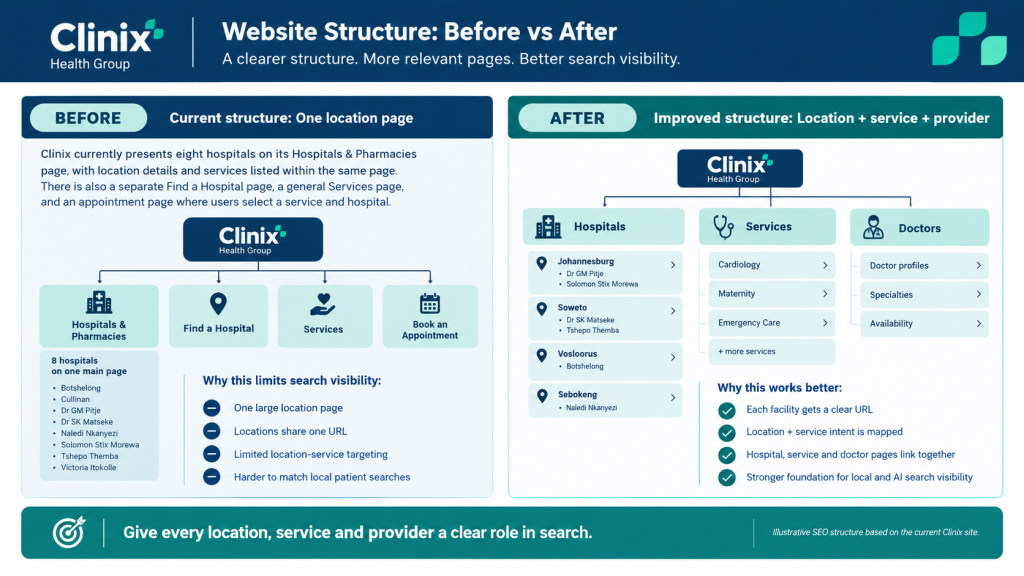
Clinix Hospital is missing a lot of opportunities in search visibility due to these factors:
- One large location page with all its 8 hospitals.
- Locations share one URL
- Limited location-service targeting
- Harder to match location searches
The “After” on the image shows how Clinix can organize its landing pages to improve visibility in search. So the takeaway is to give each location, service, and provider a role in medical SEO.
How Do Hospitals Avoid Competing Against Their Own Locations in Google?
One of the things you need to avoid is keyword cannibalization in healthcare SEO for hospitals. Keyword cannibalization is when two or more pages target the same search. Google finds it challenging to decide which of your pages deserves visibility.
Here’s an example of duplicate content:
- Hospital A:
- Cardiology Services Johannesburg
- Hospital B:
- Cardiology Services Johannesburg
- Main group page:
- Cardiology Services Johannesburg
Three pages. One search. The hospitals are competing for the same keywords.
Do this instead. Create your pages based on intent. See the example below:
- Group service page based on cardiology services
- Hospital A: mention cardiology is available at Hospital A
- Hospital B: state cardiology is available at Hospital B
- Doctor page: mention that the physician is a cardiologist at Hospital A
Focus on creating unique, localized content for each medical facility to prevent keyword cannibalization. For example, highlight exclusive and specific services, amenities, and staff skills for each location.
Also, use structured data to help search engines understand what the content is about. Structured data is a standardized way to provide information about a page and to classify the page content. If you’re using WordPress, plugins, like Rank Math, are handy in applying this content format.
Using nearby search terms (acne doctor in Pretoria) in your Google Business Profile allows each location to rank for its specialized offerings. This ensures keywords don’t overlap with other branches.
Another way of managing multiple locations is adding staff photos, provider’s details, maps, images, and reviews.
Here’s an SEO checklist to minimize duplicate content.
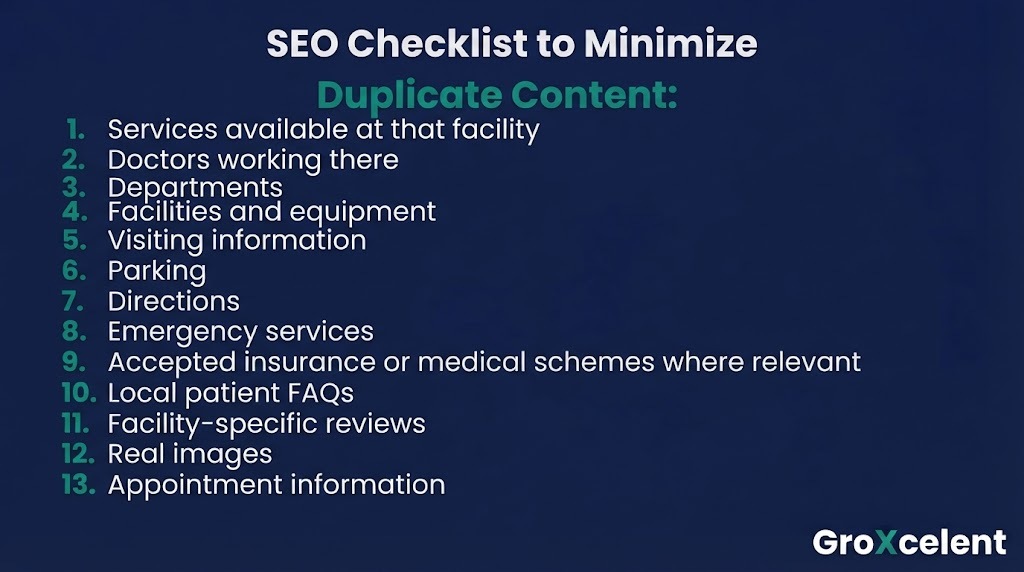
Ensure each hospital location is different by including:
- Services available at that facility
- Doctors working there
- Departments
- Facilities and equipment
- Visiting information
- Parking
- Directions
- Emergency services
- Accepted insurance or medical schemes where relevant
- Local patient FAQs
- Facility-specific reviews
- Real images
- Appointment information
Neil Patel’s current research found that 76% of multi-location businesses use mostly or completely standardized content. Only 3% fully customize content for each location.
So the problem is not having enough content. It’s lacking a system to produce differentiated content. As a result, your hospital doesn’t need hundreds of articles.
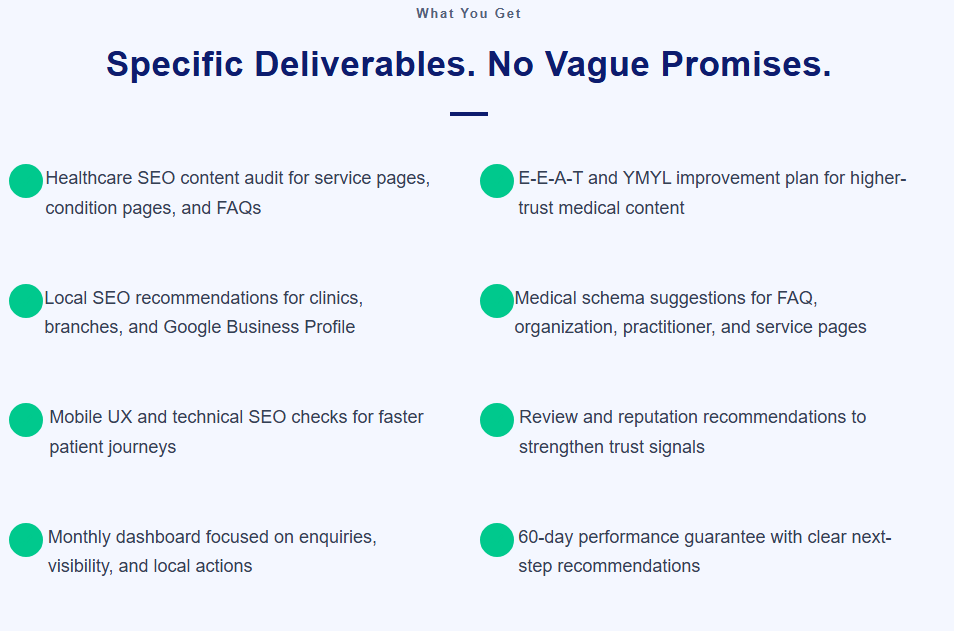
Rather, you must have a scalable system to add meaningful local content to a controlled page structure. That’s why GroXcelent’s healthcare SEO services offer the following to make each hospital unique:
How Should Healthcare Groups Decide Which Services Each Location Should Target?
Another challenge in healthcare SEO for hospitals is deciding which services to promote at each of your locations. The good news is you can use a service-location matrix to drill down on the most important and relevant services per geographic region.
Here are a few benefits of using a service-location matrix:
- Helps healthcare groups allocate services based on each location’s unique strengths and community needs.
- Improves resource use and patient care.
- Increases visibility through targeted healthcare SEO strategies.
- Enables healthcare providers to operate with efficiency.
- Positions each location to meet the specific community healthcare needs.
- Prevents a facility from creating pages for services it doesn’t provide.
And this is how you can create a service-location matrix:
Step 1:
Analyze the community’s demographics and health trends in each service area.
Step 2:
Assess each location’s current capacity and specialties, including available staff, equipment, and facilities.
Step 3:
Match the identified community needs with each location’s strengths to determine which services to prioritize and promote.
Here’s an example of a service-location matrix:
| Location | Cardiology | Oncology | Maternity | Orthopaedics |
| Hospital A | Yes | Yes | No | Yes |
| Hospital B | Yes | No | Yes | Yes |
| Hospital C | No | Yes | Yes | No |
With this information, map service availability, search demand, competition, revenue potential, clinical ability, and location. Also, consider current visibility, website quality, Google Business Profile strength, and existing authority.
Assign scores to each factor and rank locations based on their total scores. Focus first on those with the highest overall potential to improve SEO.
Then divide locations into:
- Tier 1: High opportunity, high priority
- Tier 2: Growth opportunity
- Tier 3: Maintain and monitor
The approach helps you answer a common enterprise problem: “I have 25 hospital locations. Where do I start?”
Therefore, healthcare SEO should follow clinical capacity and commercial priorities. You don’t have to optimize every location equally. Instead, zero in on locations where increasing visibility can increase patient inquiries and revenue.
How Can Hospitals Improve Google Maps Visibility Across Multiple Facilities?
Local SEO for healthcare providers lets you appear in Google Maps for nearby searches. For this to happen, each hospital location must have a verified and completed Google Business Profile (GBP).
Also, you must add accurate details for each branch, such as address, contact, and accepted insurance networks. It’s also vital to update existing and potential users regularly using the mini-blog section.
Here’s a summary of the local SEO checklist for each profile:
- Correct name
- Correct address
- Correct phone number
- Correct category
- Opening hours
- Services
- Photos
- Website URL
- Reviews
- Content updates
- Relevant attributes
According to Google, it’s important to accurately represent your business’s real-world presence. And you must not create more than one profile for each location. Its guidelines also allow individual doctors and departments within your hospitals to have separate profiles if they meet certain requirements.
As a result, location data is more than a medical SEO issue. It affects whether patients find the correct facility, contact the correct department, and receive accurate information.
How Should Hospitals Connect Doctors, Services, and Locations for Better SEO?
Connect doctor pages with hospital locations and service pages using on-page SEO. It involves optimizing individual web pages to gain more visibility and earn more relevant traffic in search engines.
Interlink doctor profile pages, hospital location pages, and service pages with relevant keywords and detailed meta tags. Meta tags are pieces of code within the webpage’s HTML, such as title tags, meta descriptions, and keyword tags.
Start by creating in-depth landing pages for each practitioner that link to related medical services and department pages. This improves the user experience and helps patients easily navigate between doctors, services, and locations.
Overall, on-page SEO can boost your search visibility and patient engagement. Use the three-entity model below that involves the location, service, and provider to map out the SEO strategy.
Here’s an example:
Location: Johannesburg Hospital → Cardiology (service) → Dr. Smith (doctor). So each entity should link to the others where relevant.
- Doctor page links to hospital location
- Doctor page connects to specialties
- Service page links to doctors
- Service page links to locations
- Location page connects to services
- Location page links to doctors
Bear in mind that Google’s organization supports multiple physical addresses for organizations operating across cities or regions.
How Can Healthcare Groups Optimize for AI Search Across Multiple Locations?
Healthcare SEO services also incorporate the impact of AI assistants on search. That’s because patients increasingly use AI models to ask long questions or type AI prompts, like
- “Which hospitals near Johannesburg offer oncology services?”
- “What’s the best hospital for maternity care near Pretoria?”
- “Which hospital has a cardiology department near me?”
As a result, research on the relevant conversational queries to understand what your patients are searching for. You can use AI SEO tools, like Otterly or Profound, to dive deeper into these prompts and answer them clearly on your digital platforms.
Also, identify relevant online directories to list your hospital group and locations to improve your content’s visibility to AI search algorithms. Regularly update your content in the same directories, community forums, and in GBP to increase search relevance. Encourage patient reviews and interactions in your GBP.
Keep in mind that AI search optimization for hospitals isn’t stuffing AI prompts into pages. Instead, you want to make your medical facility easy for machines to understand and for patients to verify.
How Should Hospitals Measure Multi-Location SEO Performance?
Healthcare SEO for hospitals is incomplete without monitoring the right metrics. To measure SEO performance across multiple locations, focus on each location with its service line, provider, search intent, and conversion.
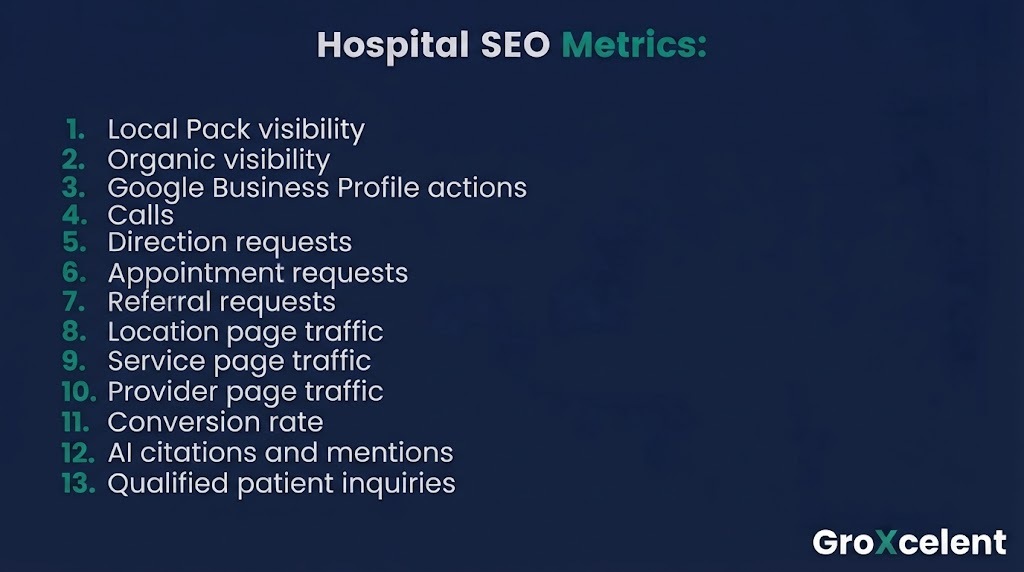
Here are examples of KPIs you need to track:
- Local Pack visibility
- Organic visibility
- Google Business Profile actions
- Calls
- Direction requests
- Appointment requests
- Referral requests
- Location page traffic
- Service page traffic
- Provider page traffic
- Conversion rate
- AI citations and mentions
- Qualified patient inquiries
Your reporting question should therefore be, “Which locations and services are capturing patient demand?” Not “How much traffic did the website get?” Traffic alone isn’t enough. Conversions, like appointments, are essential.
What Should a GroXcelent Multi-Location Healthcare SEO Strategy Look Like?
A multi-location SEO strategy for your hospital group should focus on improving conversions, like appointments or admissions. Partnering with GroXcelent helps you achieve these business goals. This is why.
We use the AI SEO framework below:
- Map patient search intent.
- Build the location-service-provider system.
- Assign high-intent keywords to the correct page types.
- Create useful location pages.
- Optimize each eligible Google Business Profile.
- Connect locations, services, and providers through internal links.
- Build healthcare and local authority using digital PR.
- Optimize medical content for AI search.
- Prioritise high-value locations.
- Measure SEO performance by location.
FAQs
| What is healthcare SEO for hospitals? It’s the process of improving search visibility for multiple hospitals, clinics, and healthcare facilities under one healthcare organization in Google and AI assistants. |
| Should every hospital location target the same keywords? No. Assign search intent based on location, service availability, and patient demand. |
| How do hospitals avoid duplicate location pages? Use a shared structure but populate each location with specific information relevant to that facility, like staff skills and photos. |
| Should every hospital have its own Google Business Profile? Yes, each hospital branch must have a separate Google Business Profile so it can rank for its local searches. |
| How does AI search change hospital SEO? Hospital SEO must adapt to AI models that look for consistent, structured, and trustworthy content. Patients also type conversational queries into AI search engines. |
| How long does multi-location healthcare SEO take? Multi-location SEO for hospitals depends on the number of locations and facilities, current visibility, website condition, project scope, and AI optimization strategies. |
Conclusion
Healthcare SEO for hospitals is more complex than managing a single location. It involves a great deal of moving parts that require a strong management system. A healthcare SEO agency can be helpful in creating and executing medical SEO.
You don’t need more SEO activity. You should have a system connecting locations, services, providers, and patient searches.
Discuss your multi-location SEO strategy with GroXcelent today.