
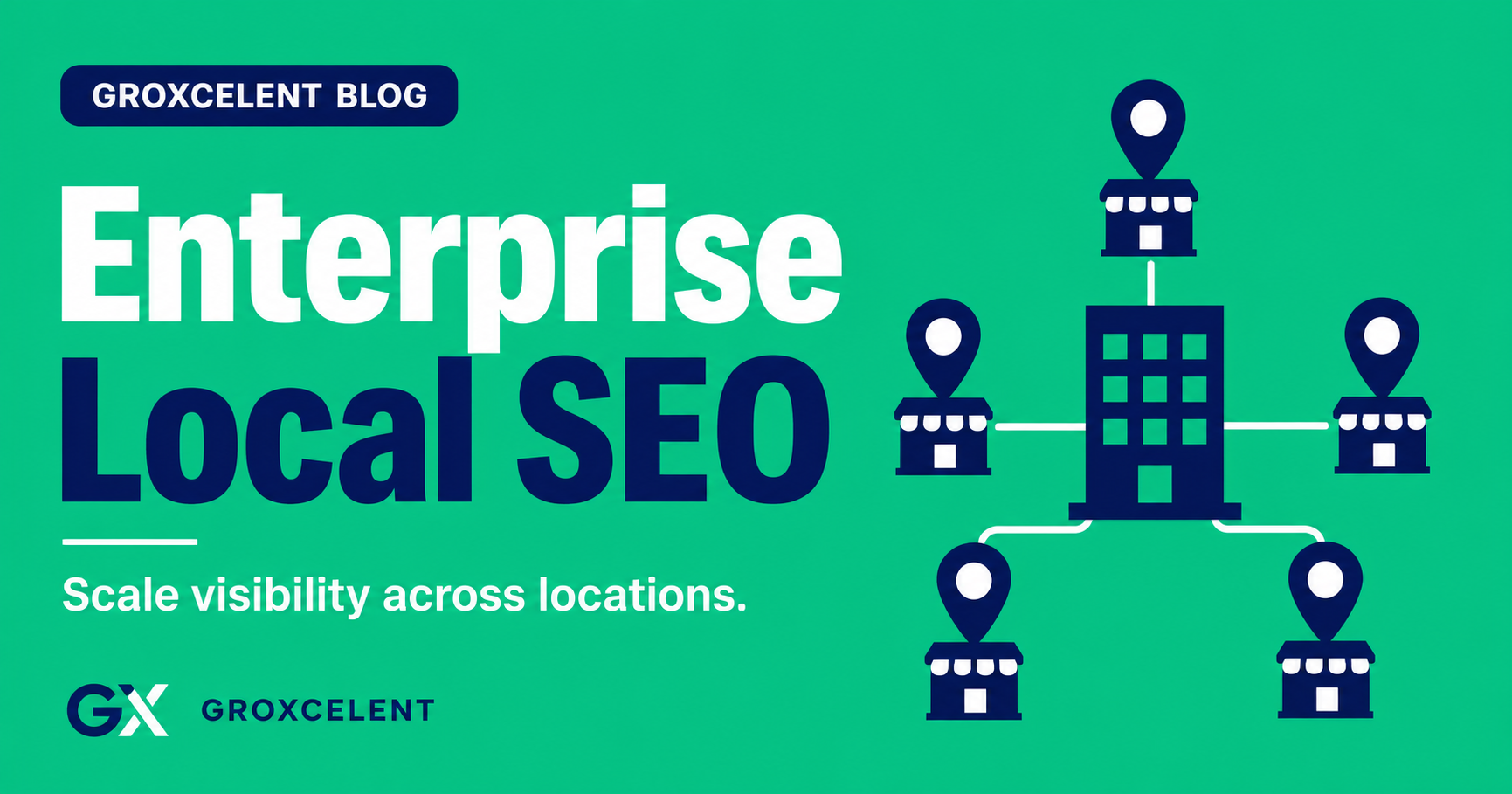
Large brands with hundreds of locations should develop an enterprise local SEO strategy to manage their online visibility, reputation, and performance.
Online data suggests that 90% of customers buy from businesses they trust. This makes local SEO for multiple locations vital for your brand.
In this guide, I’ll unpack what enterprise local SEO means for your big business and how you can implement a national SEO strategy to improve traffic and conversions.
GroXcelent offers affordable SEO for small businesses with multiple locations.
Key Takeaways:
| 1. Enterprise local SEO requires managing multiple Google Business Profiles for various locations. 2. Consistency in NAP data is crucial across all platforms to maintain accurate information. 3. Using the best enterprise SEO software helps you manage thousands of locations. 4. Building local link-building strategies is key to improving visibility and driving traffic. 5. Developing a governance structure ensures brand consistency across multiple locations. |
TL;DR: What Is Enterprise Local SEO and What Does It Mean for Large Brands?
Enterprise local SEO is a technique of managing a large business’s online visibility to drive traffic and rank in local search results across every location and market you operate.
You want to improve the online presence of hundreds, even thousands, of service areas for different brands under the same corporate identity.
View enterprise local SEO as local SEO search at scale. It’s multi-location SEO.
Local SEO for multiple locations can drive real business growth.
- Brands that rank in the top 3 map results in the Google Map Local Pack receive nearly 126% more traffic. And they increase calls or clicks by 93%. (SOCI)
- 72% of consumers rely on Google to research local business information. (BrightLocal)
Why Is Enterprise Local SEO Different from Small Business Local SEO?
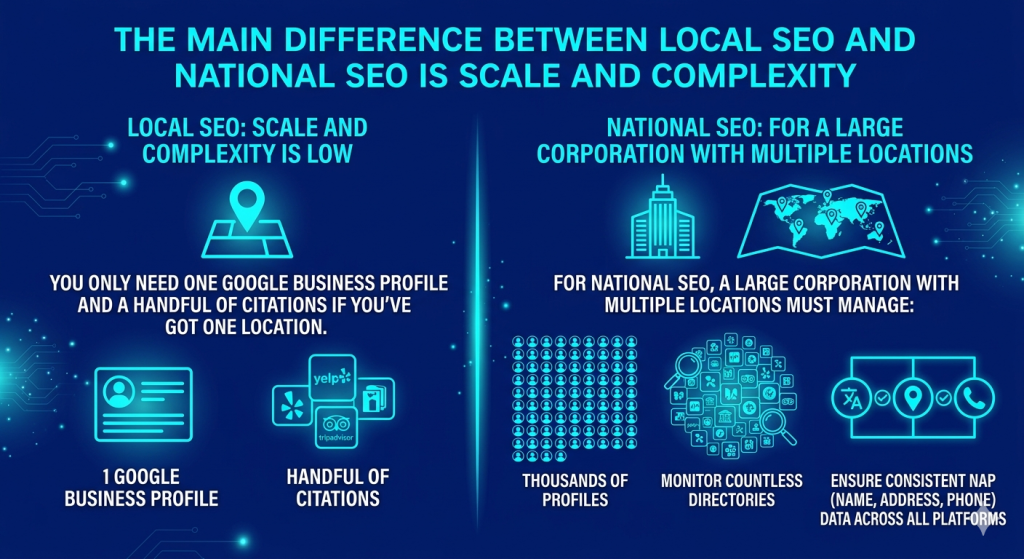
The main difference between local SEO for SMEs and national SEO is scale and complexity. You only need one Google Business Profile and a handful of citations if you’ve got one location.
For national SEO, a large corporation with multiple locations must manage:
- Thousands of profiles.
- Monitor countless directories.
- Ensure consistent NAP (Name, Address, Phone) data across all platforms.
Additionally, you must manage your crawl budget effectively and avoid duplicate content that can confuse AI search engines.
What Does Enterprise Local SEO Mean for Your Business With Dozens or Hundreds of Locations?
Because you’re dealing with multi-location stores, you should implement a scalable framework and governance guidelines.
This also means moving away from manual processes to automated workflows.
Such a system ensures that every storefront, brand, or franchise appears in nearby search results, the local map pack, Google Maps, and AI citations.
Let’s look at each one in detail:
1. Scale and complexity
Standard local SEO operates on a per-location basis. Enterprise local SEO occurs holistically. You must consider:
- Multiple Google Business Profiles instead of one
- Location pages for every store or office, plus locator experiences
- Centralized rules that allow for local context
- Using the same data across multiple systems and vendors
2. Governance and risk
To make enterprise local SEO a success, you should develop a reliable governance framework. This means being clear about ownership, who approves what, and what workflows you use.
For example, inaccurate details about your brand, such as outdated hours or an incorrect address, can harm its reputation. Or unmonitored reviews can be damaging.
As a result, governance must take center stage in your enterprise local SEO strategy to avoid these problems.
3. Central strategy, local relevance
Enterprise local SEO requires you to set systems, guardrails, and standards for everyone to follow. Every market, service area, or location uses the documented process to add local content, offers, and other details. There’s no guesswork.
ProTip: Build a system that keeps every location accurate, visible, and locally relevant at scale. This prevents burnout of your marketing team.
TL;DR: How Do You Manage Local SEO Across Multiple Locations at Scale?
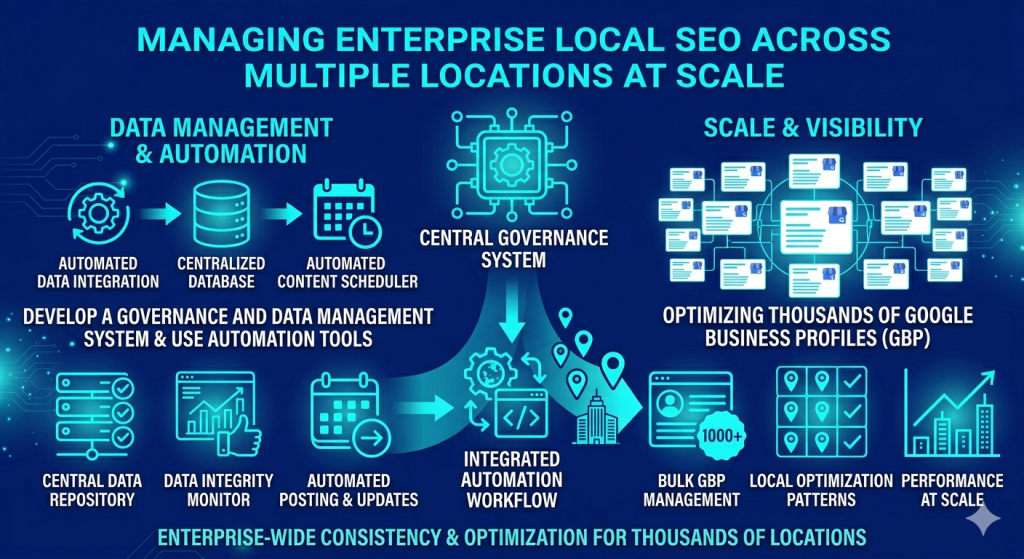
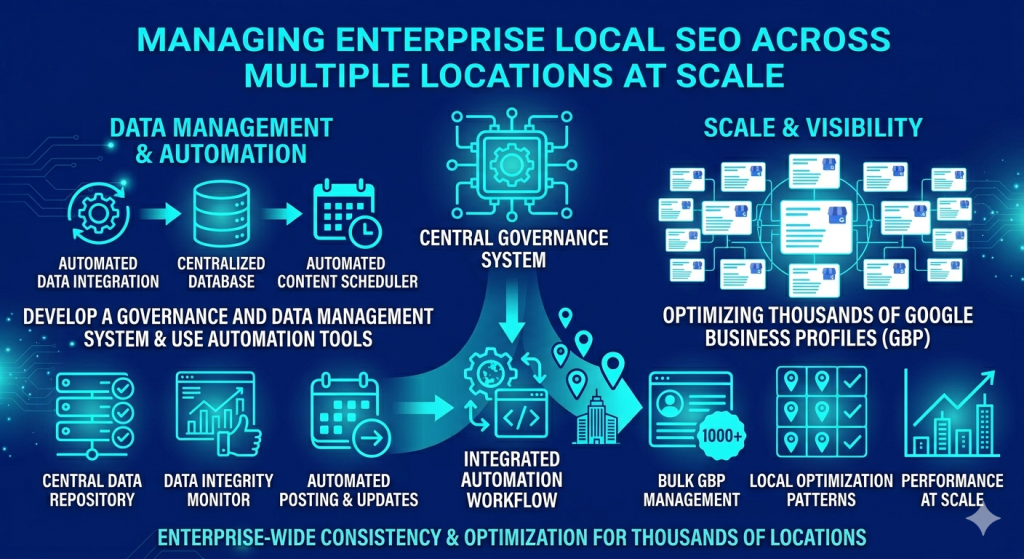
To manage enterprise local SEO, you need to develop a governance and data management system, use automation tools, and optimize thousands of Google Business Profiles.
What Does a Centralized Governance and Data Management System Look Like?
Create a single source of truth for all your locations to manage data effectively. This means each service area has one owner, one system, and one record.
Build a real single source of truth
Every location record should include:
- Standardized name, address, phone, and primary categories
- Business hours, special hours, and temporary closure logic
- Core services or product flags that map to SEO content blocks
- Attributes that matter to customers, such as parking, access, or amenities
One person must own this data and approve any changes.
Apply data governance rules.
Consider the following questions to create the rule:
- Who can request changes for a location?
- What must you approve at the corporate level versus what can you change locally?
- How to handle openings, closures, relocations, and rebrands
- Which systems do you allow to push location data to search engines and directories?
ProTip: Use a data management tool to handle these issues.
Connect data to every local SEO asset
Your single source of truth should feed:
- Google Business Profiles and other major listing endpoints
- Location pages, store locator, and any local landing templates
- Analytics and reporting so that you can segment performance by accurate location data
How central oversight protects brand and SEO
Centralized governance supports your brand integrity and search performance. This is how it works:
- Brand protection, consistent naming, categories, and messaging across regions
- Customer trust, accurate hours, and location info that match what people see on-site and in-store
- SEO stability, fewer conflicting signals about which locations exist and how they operate
- Operational sanity, one process for fixes instead of fire drills across multiple teams
What Is the Right Location Page Architecture for Enterprise Websites?
Your URL structure must be logical and scalable. For example:
- www.example.com/locations/manhattan
- www.example.com/locations/brooklyn
- www.example.com/locations/johannesburg
- www.example.com/locations/durban
Avoid dynamically generated URLs that confuse crawlers. These are URLs that are created when a user submits a search query.
Instead, use static and descriptive URLs. Also, create a dedicated XML sitemap for all location pages to submit via Google Search Console. This ensures Google discovers and indexes your service pages.
ProTip: Use an SEO plugin to generate a sitemap.
How Do You Optimize Google Business Profiles for Hundreds of Locations?
Every location must have its own fully optimized Google Business Profile (GBP).
Follow these local SEO best practices:
- Complete every field with accurate NAP, hours, and categories
- Add location-specific attributes (e.g., “outdoor seating,” “appointment required,” “wheelchair accessible”)
- Upload high-quality photos of each specific storefront
- Use GBP posts to announce local promotions or events
Businesses with complete profiles are 76% more likely to get store visits and 50% more likely to earn purchases (Backlinko)

What Are the Best Tools for Enterprise Local SEO?
Manual processes, like spreadsheets, are not the best way to manage local SEO for multiple locations.
Instead, consider enterprise SEO platforms to automate the entire system.
Here are the features to look out for when choosing enterprise SEO software:
| Feature | Function |
| Listing management | Create, update, suppress, and sync location data across Google’s major maps and directories from your single source of truth. |
| Rank and visibility monitoring | Track local rankings by location, keyword group, and market segment. |
| Location page management | Connect your CMS to structured location data to generate and update pages programmatically with controlled templates |
| Review and Q&A operations, | Centralize monitoring, routing, and response workflows |
| Reporting and alert | Automate dashboards; track map rankings, scheduled reports, and threshold alerts for issues like listing suspensions, ranking drops, or data mismatches. |
| Data health auditing | Continuously scan for NAP conflicts, broken location URLs, missing schema, and profile inconsistencies. |
| Architecture for scale | Handle the full location count with room to grow |
| Automation with guardrails | Provide templates, scheduled jobs, and bulk updates, paired with preview, version history, and rollback to move fast without wrecking production data. |
| Location-centric reporting | Access to views by brand, region, format, or individual store. |
| Governance support | Approve queues, audit trails, and change logs that satisfy internal compliance |
TL;DR: What Are Advanced Citation Strategies for Enterprise Local SEO?
National SEO citation techniques involve structured and unstructured citations, and Generative Engine Optimization (GEO).
What Are Citations in Local SEO, and Why Do They Matter for Enterprises?
Citations are references to your company’s Name, Address, and Phone number (NAP) that appear online on third-party platforms. They help Google verify if your business is legitimate and operates at real sites.
Customers also use citations when looking for a specific service or store in your area. So they must be accurate.
Citations can be structured or unstructured.
- Structured citations are formal listings on business directories like Google Business Profile, Yelp, Apple Business Connect, and industry-specific platforms.
- Unstructured citations are business mentions on blogs, news sites, social media, press releases, or forums.
Both groups are important. Structured citations build your foundation while unstructured citations build contextual relevance and authority.
Don’t chase hundreds of low-quality directories. Here are top citations your brand must prioritize:
| Citation | Example |
| Major platforms | Google Business Profile Yelp Apple Business Connect Bing Places |
| Industry-specific directories | TripAdvisor for hospitality FindLaw for legal ZocDoc for medical |
| Geography-specific directories | Local chambers of commerce City business hubs |
| Data aggregators | Data Axle Foursquare |
What Is the Role of Citations in Generative Engine Optimization (GEO)?
AI browsers like Perplexity. ChatGPT and Google’s AI Overviews extract information from multiple sources to answer a search query. They scrape structured citation data and reviews from directories like Yelp and TripAdvisor when users ask AI for local recommendations.
This means that if your citations are strong, they can influence traditional and AI search engines and rankings. For example, GroXcelent is listed on Goodfirms, a trusted platform for different types of industries. This may send positive signals to AI search engines, leading to inclusion in AI citations.
TL;DR: What Are the Strategies for Local Link Building for Large Companies With Many Branches?
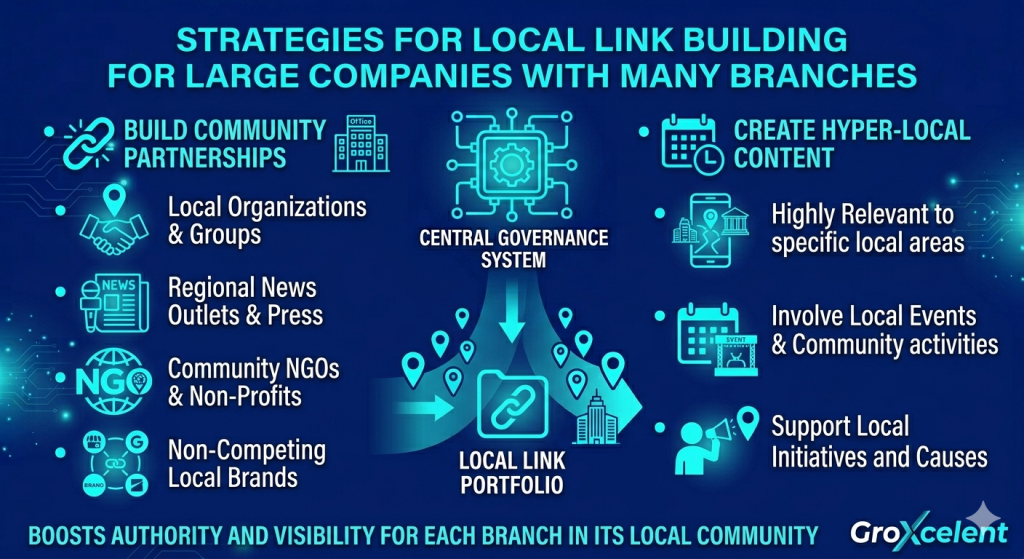
Local SEO link-building strategies focus on building community partnerships with local organizations, news outlets, NGOs, and non-competing brands. They also include creating hyper-local content relevant to your location.
What Is Local Link Building for Multi-Location Businesses?
Local link building is when your website earns backlinks (votes of confidence) from other relevant websites located in the area you operate.
These links signal to search engines that community sources trust your brand and that it is locally relevant. AI browsers can cite you as an authoritative and trustworthy source in your particular service area.
This improves your visibility and rankings.
Here are several ways of earning local links without a PR team at every location:
1. Sponsor local events and organizations
Sponsor little league teams, charity runs, or community festivals. Ask these bodies to list you on their event websites with a link back to your local page.
2. Partner with complementary local businesses
Find non-competing businesses and collaborate on promotions.
For example, a bakery could partner with a nearby coffee shop to offer discounts for customers who visit both. Then each business links to the other on its website.
3. Create locally valuable content
Develop “Best of [City]” guides, neighborhood spotlights, or local resource pages. These attract links from local blogs, chambers of commerce, and community sites.
4. Explore local news and press releases
Announce new store openings, community contributions, or local hiring initiatives. Local news outlets often cover these stories and link back.
These unstructured citations often include backlinks. They act as “votes for entity validity” and show Google that local sources trust your business.
Also, Google frequently highlights these citations in search results for branded searches.
TL;DR: What Are Technical Foundations for Enterprise Local SEO Success?
Multi-location brands must ensure their GBPs are accurate, manage crawl budgets efficiently, and keep CoreWeb Vitals clean.
Here are a few things to keep in mind as you work on your GBP:
- Business name, address, phone
- Geo-coordinates
- Opening hours
- Price range
- Department or subtype (e.g., Restaurant, Financial Service)
How Do You Manage the Crawl Budget for Thousands of Location Pages?
Create separate XML sitemaps for your location pages and submit them via Google Search Console. This helps search engines discover and index new location pages efficiently without wasting crawl budget on dynamically generated URLs.
Why is Mobile Optimization Critical for Enterprise Local SEO?
Local searches happen predominantly on mobile devices. Ensure location pages load quickly, display properly on small screens, and include click-to-call buttons.
Core Web Vitals directly impact both local and organic visibility. This is because slow pages hide your best content. Users can leave your website, increasing the bounce rate.
AI engines also favor fast-loading website pages.
TL;DR: How Do You Measure Enterprise Local SEO Success?
Here are the metrics that matter most for multi-location SEO.
Track at both aggregate and location levels:
- Local pack rankings for primary service keywords + city
- GBP insights: profile views, direction requests, phone calls, chat clicks, menu or booking clicks from local listings
- Citation consistency scores (available in reputation management tools)
- Review volume and sentiment by location
- Organic traffic to individual location pages
- Foot traffic/conversions (tie in CRM data where possible), like online appointments, reservations, quote requests, or “buy online
- Revenue alignment: map those actions to average order value or visit value from your BI or POS system
How Often Should You Audit Enterprise Local SEO Performance?
Run comprehensive audits quarterly. Check for:
- NAP inconsistencies across directories
- Duplicate GBP listings
- Outdated hours or holiday closures
- Location pages with thin content
- Broken links or schema errors
ProTip: Use a multi-location SEO platform to audit your Google Business Profiles.
TL;DR: When Should You Bring in Enterprise Local SEO Experts?
Consider working with a professional local SEO company when you see these signs:
- You’re managing locations manually with spreadsheets and making errors
- GBP listings have inconsistent hours or duplicate profiles
- Your locations aren’t showing in the Local Pack despite having physical addresses
- You’re getting zero clicks from branded local searches
- Competitors consistently outrank you in key geographic markets.
An enterprise local SEO partner like GroXcelent can help you scale.
We bring:
- Enterprise-grade tools and platforms without the learning curve
- Governance frameworks proven across similar industries
- Bulk citation management and cleanup expertise
- Local link-building programs that actually scale
- Regular performance reporting with actionable insights
FAQs
| How does enterprise local SEO differ from small business local SEO? Enterprise local SEO is a set of techniques for managing hundreds of locations of a large business’s online presence, reputation, ranking, and performance. It’s multi-location SEO. Local SEO for a small business involves monitoring one Google Business Profile and a few citations. It’s local SEO on a small scale. |
| How to choose an enterprise local SEO platform for a large business Consider list management, data handling, reporting and analytics, ranking and visibility monitoring, automation, location page management, and governance support capabilities. |
| What are the strategies for local link building for large companies with many branches? Link-building strategies involve using structured and unstructured citations and developing partnerships with local organizations, such as NGOs, media outlets, and colleges. |
| How do you measure enterprise local SEO performance? Track GBP metrics, such as profile views, individual pages’ organic traffic, direction requests, calls, chats, and website clicks. Also, consider conversions and revenue KPIs. |
| What companies offer enterprise-level local SEO consulting? GroXcelent is the SME Growth Agency that offers enterprise SEO consulting services. |
Conclusion
Enterprise Local SEO requires three pillars to succeed: scalability, governance, and multi-location local SEO platforms. Audit your current location, choose the best enterprise local SEO software, create governance guidelines, and monitor and refine enterprise local SEO performance.
GroXcelent is the SME Growth Agency that enables large companies with thousands of locations to develop an enterprise local SEO strategy. We’re laser-focused on visibility, reputation management, and revenue.
Talk to national SEO experts today to drive growth and revenue.