

| What is a major challenge for small businesses? Time management is one of the major constraints for SMEs. |
You’re a busy founder. Your schedule is full, so you push marketing aside most of the time.
This happens to most SMEs since they struggle with resource limitations.
In this article, I provide a clear plan on how to improve your time management.
Also, I’ll show you how to prioritize marketing for your small business. These are more than productivity tips for entrepreneurs.
That’s because the time management techniques enable you to regain control of your time, be productive, and achieve your company goals.
GroXcelent empowers business owners like you to find time for growth. I’ll unpack more about this later.
The Time Trap: Why Is Time Management for Marketing a Major Struggle?
TL;DR: As an SME founder, daily operations overwhelm you. They leave you with no time for consistent marketing, which leads to missed opportunities.
You wear many hats, as daily tasks fill your day. Sales calls, customer service, and management take priority.
| Ed Carey of the Self-Employed Business Academy says, “Small businesses face a distinctive set of obstacles in managing their time. The pressures of daily tasks, interacting with customers, and mapping out strategies can swiftly become daunting.” |
As a result, marketing becomes a low-priority task. And the numbers on time management don’t lie.
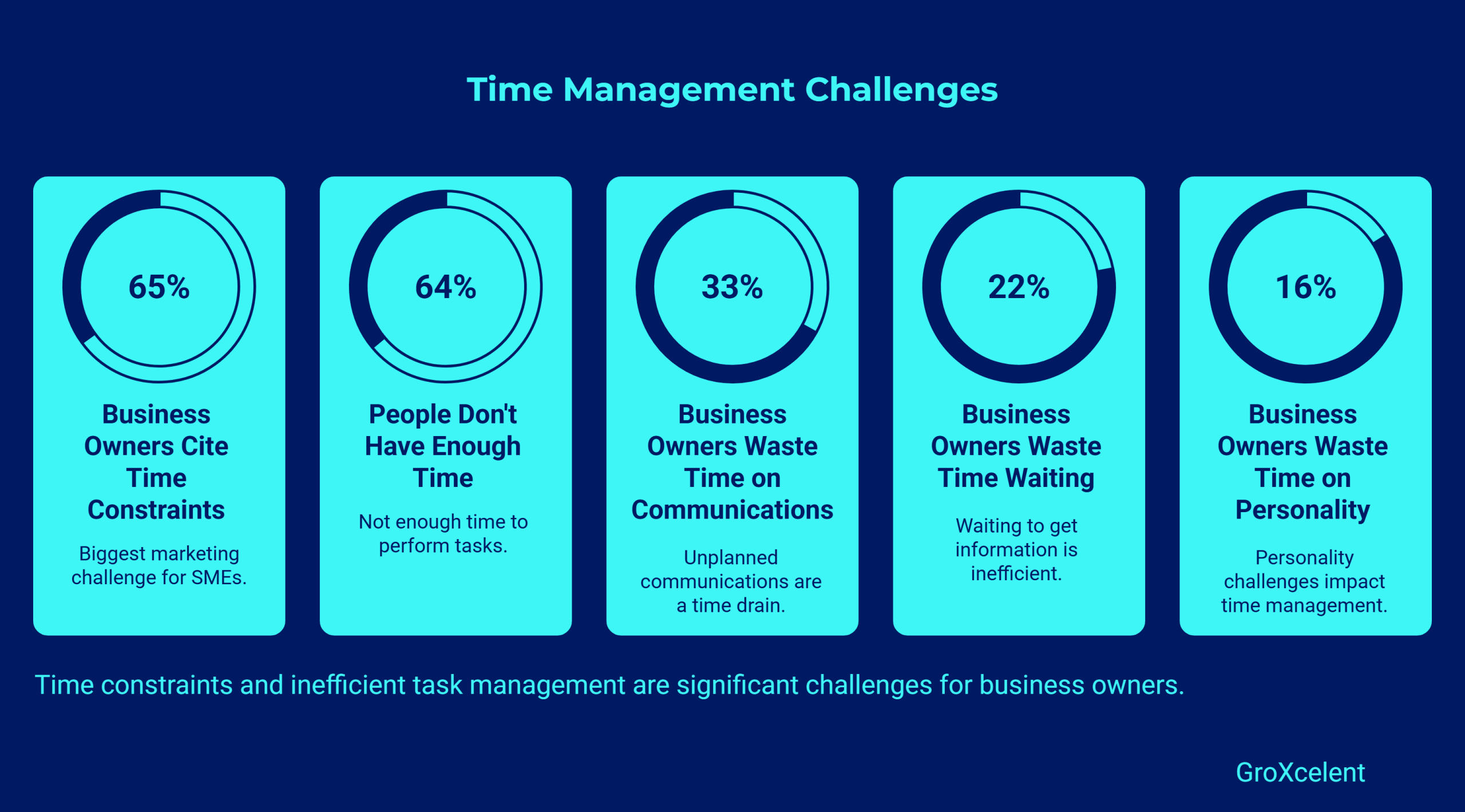
- 65% of business owners cite time constraints as their biggest marketing challenge (kbbreview).
- 64% of people say that they don’t have enough time to perform their tasks (Hubstaff).
- Business owners spend 7 hours on low-value tasks such as constant meetings (DigiWorks).
- They also waste time on unplanned communications (33%), waiting to get information (22%), and personality challenges (16%) (The Alternative Board)
Because of these factors, your marketing becomes inconsistent. Your competitors get ahead, and your brand presence weakens.
Here are more consequences of poor time management:
- Revenue losses
- Increased operational costs
- Efficiency and productivity losses
- Increased risk of burnout
Time management is the ability to make the most of your time, be productive, and reach your daily business activities. Your success as an entrepreneur depends on how you manage time effectively.
The 80/20 Rule: What Are the Highest-Impact Marketing Tasks?
TL;DR: Focus 80% of your marketing time on the 20% of tasks that produce the best results.
You have probably heard about the 80-20, or Pareto, principle.
As a reminder, it states that big outcomes (the 80%) emanate from a small proportion of your efforts (the 20%) and vice versa.
Watch this brief video about the 80/20 rule.
| This means that “the Pareto principle should remind us about our time management when managing marketing. We should focus our time on our main customer segments, most popular products and the biggest causes of customer dissatisfaction.” Dr Dave Chaffey, co-founder of Smart Insights. |
In our case, not all marketing tasks are equal. Some activities drive more growth than others.
As a result, you should identify high-impact and low-impact marketing activities. I consider SEO, PPC ads, email marketing, digital PR, and copywriting as high-value tasks.
This is why:
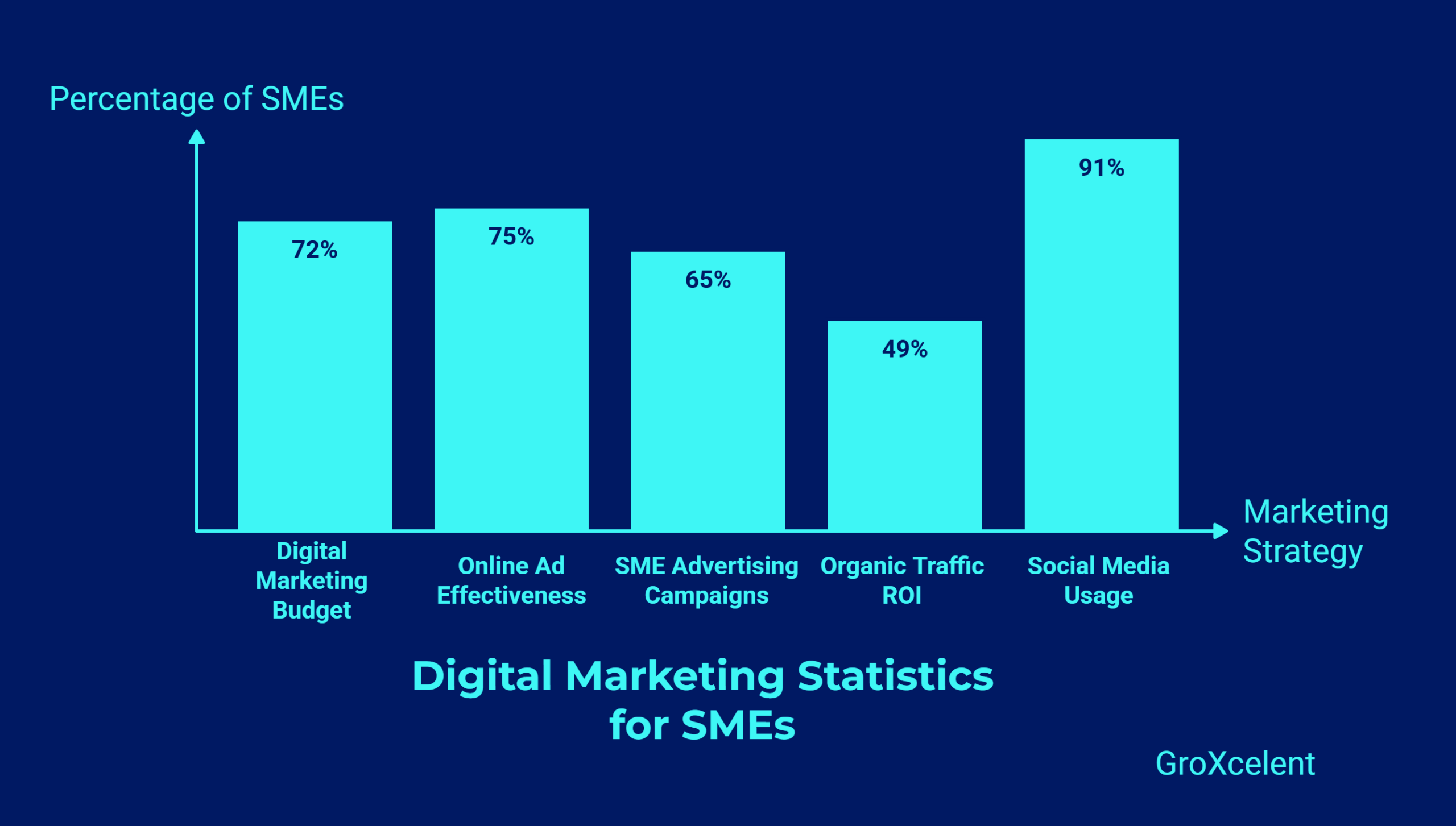
- 72% of budgets are allocated to digital marketing (Webstrategic)
- 75% of people say online ads make it easy to find what they’re looking for (Webfx)
- 65% of SMEs have an advertising campaign (Webfx)
- 49% of businesses say that organic traffic has the best marketing ROI (Backlinko)
- SMEs spend between $1000 and $5000 per month on SEO. (Wordstream)
- Content marketing helps SMEs grow organically by generating leads at low costs (Wordstream)
- 91% of businesses use social media for their marketing (Statista)
- Email marketing has the highest marketing ROI, according to SMEs (HubSpot)
As an SEO professional who has worked for marketing agencies, I view the activities below as time-consuming.
- Posting to every social media channel daily
- Constant minor website tweaks
- Chasing vanity metrics analysis.
Based on the 80/20 principle, focus your attention on marketing efforts that bring a significant return to your business. It helps you manage your time with efficiency.
Strategic Delegation: How Can You Outsource Low-Impact Tasks?
TL;DR: Free up your time by outsourcing repetitive or specialized marketing tasks to an expert partner.
You don’t need to do everything yourself. DIY marketing has limitations such as:
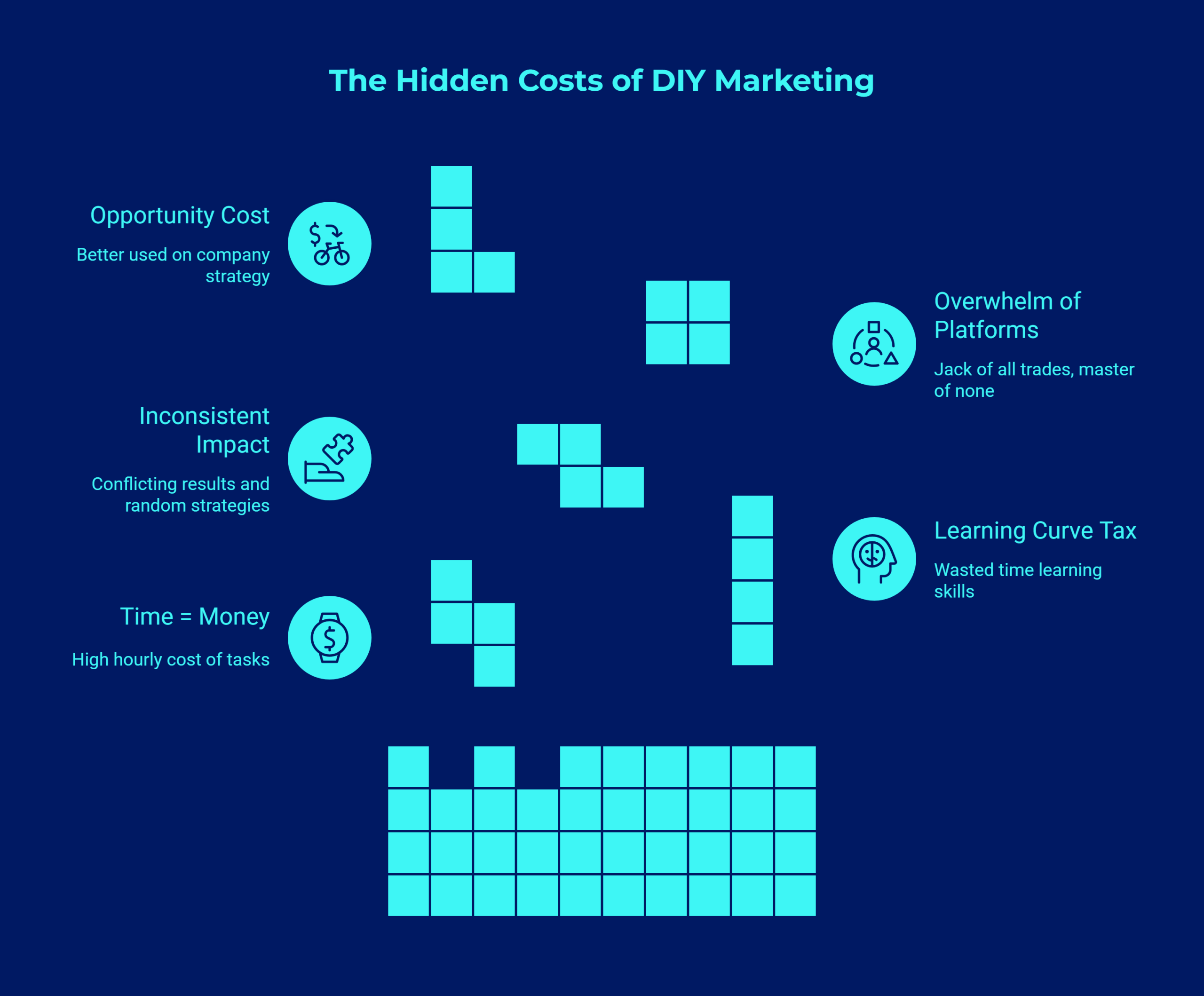
- Consumes time: Digital marketing is a challenging role, so adding it to your already full plate can compromise your results.
- Limits your expertise: Online marketing is so broad that it may be impossible for you to perform SEO, email nurturing, and ads by yourself.
- Inconsistency: It’s challenging to maintain a consistent and uniform brand identity and messaging if you’re doing everything yourself.
- Opportunity cost: You forfeit hours that you can spend on strategic planning and customer service when you invest your energy in marketing activities.
As a result, delegating tasks is a smart strategy. It lets you offload some tasks to competent people.
| “It’s also worthwhile to remember that by delegating whenever possible, you help yourself grow because you give yourself space to take on the newest, most challenging tasks yourself and can delegate someone else to handle the smaller, everyday items on your to-do list.” Tonny Robbins, business coach. |
DDI Data shows that delegation is an effective approach to reducing burnout and improving productivity.
Consider these delegation strategies for your small business:
- Delegate AI SEO, technical SEO audits, PPC ads, email marketing, copywriting, social media, and digital PR to a digital marketing agency.
- These are complex digital marketing activities that require specialist skills and laser-focused attention.
- Keep strategic planning, brand messaging, and customer communication. These tasks need your direct input.
“Outsourcing tasks is a critical skill that every successful entrepreneur and Fortune 500 CEO has to master and, so do you.” Tonny Robbins.
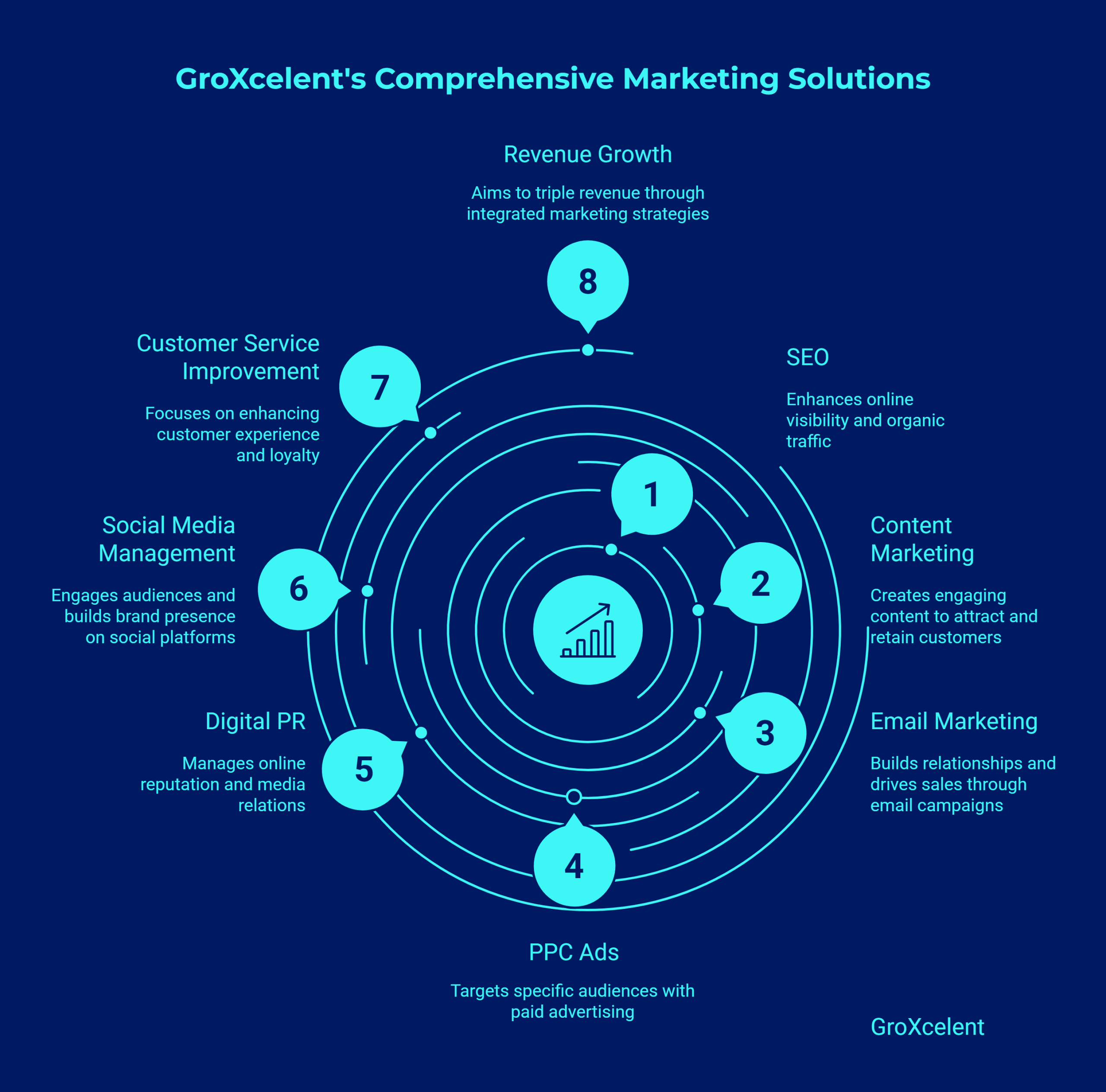
Partnering with GroXcelent helps you manage your time effectively. We take care of SEO, content, email marketing, PPC ads, digital PR, and social media.

You can have peace of mind knowing that tried and tested marketers are handling your digital marketing to enhance your bottom line.
Also, outsourcing marketing activities lets you focus on vital company roles such as improving customer service.
The result? Your buyers become happy and loyal to your business.
Online data suggests that satisfied customers can increase your sales by 2-7% and profitability by 1-2% (McKinsey). And 3 in 4 buyers spend more with a brand that has a good CX (Zendesk).
As an AI SEO agency, GroXcelent integrates SEO, content, social media, digital PR, email, and PPC ads to improve your visibility and triple your revenue.
“[By] delegating or [outsourcing] when necessary, business owners can stave off burnout and foster a more productive and prosperous business atmosphere.” Edy Carey
You can improve your time management by delegating some marketing tasks to a digital marketing partner.
Batching and Planning: How Can You Organize Your Marketing Work?
TL;DR: Group similar tasks together and plan your content in advance to increase efficiency.
Switching between tasks is inefficient. Batching saves time.
| Tonny Robbins explains further: “ If you’re facing an overwhelming number of tasks around an outcome, remember that you can create better to-do lists by chunking all related tasks into smaller groups so that they are easier to manage and tackle. That way, you can better visualize and identify the steps you need to take to reach your goal.” |
Batching examples might look like this:
- Dedicate one hour to writing all social media posts for the week.
- Commit another hour to performing research on your customers, conversational queries, long-tail keywords, and more.
- Also, create a simple content calendar. Plan your content a month in advance to prevent last-minute stress.
FAQs on Time Management for Small Business Owners
| What is the 80/20 rule for time management? The 80/20 rule, also known as the Pareto Principle, means that 20% of your effort or input results in 80% of output and vice versa. You should zero in on high-impact marketing activities that give you a big return on your investment. |
| What are the three key strategies of time management? Three time management techniques involve applying the 80/20 rule, outsourcing or delegation, and batching. |
| What do most small business owners struggle with? Business founders struggle with effective time management. |
| Which time management suggestion would be the most critical for a small business owner? Evaluate how you spend your time in marketing to identify high-impact and low-impact activities. Outsource repetitive, technical tasks to a marketing partner like GroXcelent. |
| How can poor time management make your business suffer? It causes burnout, a lack of focus, productivity and revenue losses, and poor customer service. |
Take Control of Your Time To Crush Your Marketing Goals
Time is your biggest marketing challenge. You can overcome it by prioritizing high-impact tasks.
Effective time management for your small business means you’re productive and can meet your daily goals without burnout or sacrificing other vital activities.
So it makes good business sense to outsource specialized marketing responsibilities like technical SEO, digital PR, email nurturing, and digital advertising to a marketing partner.
GroXcelent is an AI SEO agency for start-ups and growing SMEs. Working with us can improve your time management and bottom line.
Ready to save time and grow your business with seasoned marketers? Get your free SEO audit to find high-impact opportunities.